
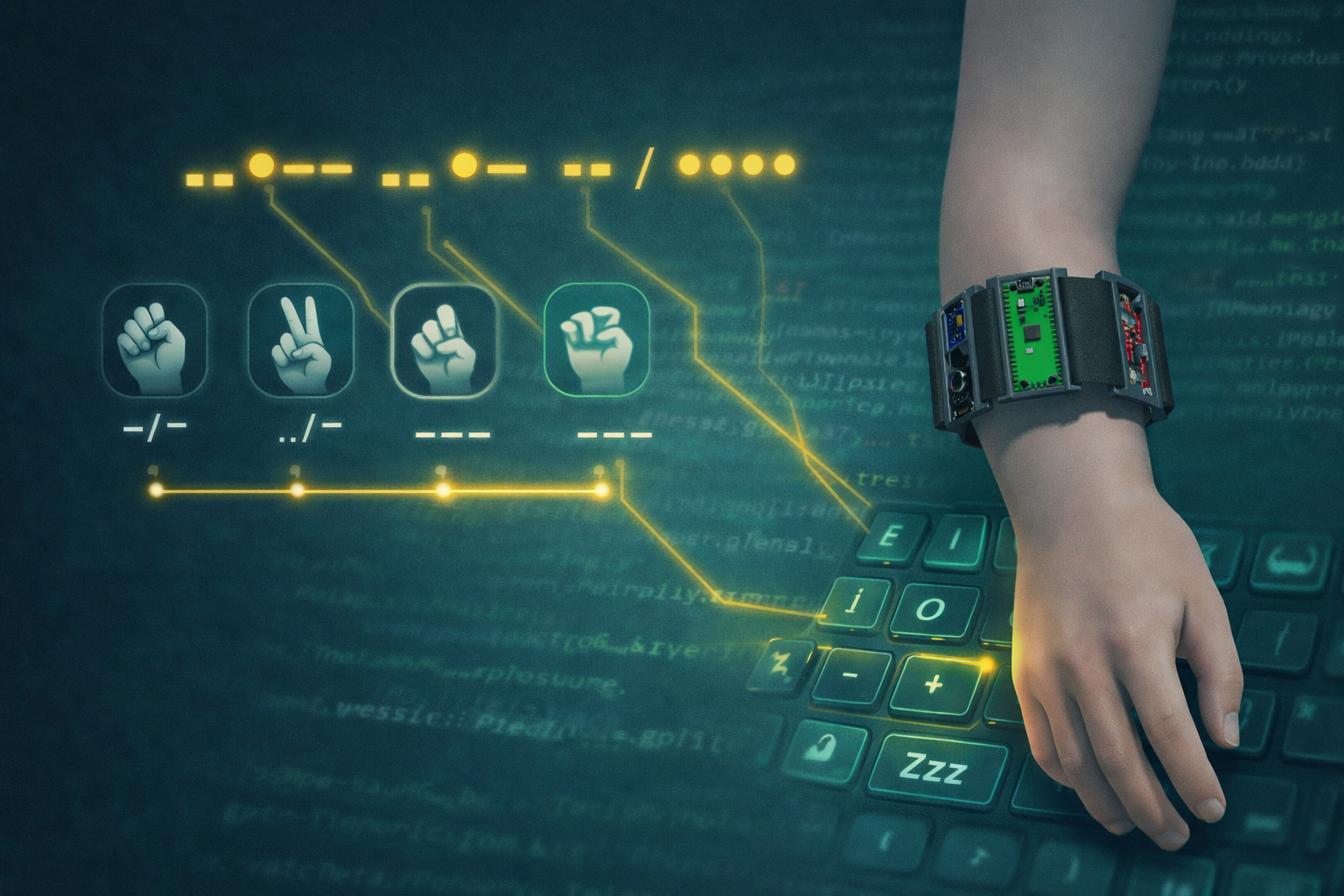
TinyML para tecnologías de asistencia: dispositivo de bajo coste basado en gestos inspirado en el código Morse
DOI:
https://doi.org/10.17081/invinno.14.1.8496Palabras clave:
TinyML, señal EMG, tecnología de asistencia, gestos de código Morse, sistemas embebidosResumen
Objetivo: Desarrollar un dispositivo de asistencia a personas con discapacidad en las extremidades superiores, utilizando aprendizaje automático con control de gestos inspirados en código Morse para dispositivos de baja potencia.
Metodología: Está basada en un enfoque experimental y aplicado, adecuado para el desarrollo. Consta de cuatro etapas: selección del sensor y sistema embebido, para asegurar la viabilidad técnica; diseño del sistema electrónico, para garantizar la adquisición de señales; desarrollo del modelo de aprendizaje automático, orientado a la clasificación de gestos; y evaluación del sistema, para validar su precisión.
Resultados: Se obtuvo una precisión del 93,3 % para traducir gestos en eventos de teclado. El modelo propuesto presenta un rendimiento de clasificación superior al 90%, especialmente en los gestos E y Zzz, donde todos los ejemplos se clasificaron con una precisión del 99,9%.
Discusiones: Se observaron errores en los gestos A y U, donde el 15% de los datos del gesto A se clasificaron incorrectamente como gesto U y viceversa. No obstante, frente a estudios previos, el dispositivo desarrollado aporta accesibilidad y portabilidad con buen desempeño.
Conclusiones: Se destaca particularmente la identificación de los gestos E, I, O y Zzz, con porcentajes de F1-Scores de 98, 95, 97 y 100 respectivamente.
Citas
[1] A. Cote, “Protección social y acceso a tecnología de asistencia en países de bajos y medianos ingresos,” Assistive Technology, vol. 33, no. sup1, pp. 102–108, 2021, DOI: 10.1080/10400435.2021.1994052.
[2] C. Ferrin-Bolaños et al., “Interfaz humano-computador basada en ges-tos faciales y orientada a la aplicación WhatsApp para personas con limi-tación motriz de miembros superiores,” TecnoLógicas, vol. 24, no. 50, pp. 72–96, Jan. 2021, DOI: 10.22430/22565337.1722.
[3] D. Andreas, H. Six, A. Bliek, and P. Beckerle, “Design and Implementa-tion of a Personalizable Alternative Mouse and Keyboard Interface for In-dividuals with Limited Upper Limb Mobility,” Multimodal Technologies and Interaction 2022, Vol. 6, Page 104, vol. 6, no. 12, p. 104, Nov. 2022, DOI: 10.3390/MTI6120104.
[4] M. Hassan, Y. Shimizu, Y. Hada, and K. Suzuki, “Joy-Pros: A Gaming Pros-thesis to Enable Para-Esports for Persons with Upper Limb Deficiencies,” IEEE Access, vol. 10, pp. 18933–18943, 2022, DOI: 10.1109/ACCESS.2022.3151094.
[5] A. Rahagiyanto, G. E. J. Suyoso, V. Vestine, and A. Iskandar, “Prototype of MyoWare (Electromyography Muscle Sensor) for Measuring People’s Muscle Strengths,” International Journal of Health and Information System, vol. 1, no. 1, pp. 19–26, May 2023, DOI: 10.47134/ijhis.v1i1.9.
[6] M. Garouche and O. Thamsuwan, “Development of a Low-Cost Portable EMG for Measuring the Muscular Activity of Workers in the Field,” Sensors, vol. 23, no. 18, Sep. 2023, DOI: 10.3390/s23187873.
[7] Q. Zhang et al., “Three-in-One Portable Electronic Sensory System Based on Low-Impedance Laser-Induced Graphene On-Skin Electrode Sensors for Electrophysiological Signal Monitoring,” Adv Mater Interfaces, vol. 10, no. 3, Jan. 2023, DOI: 10.1002/admi.202201735.
[8] P. P. Ray, “A review on TinyML: State-of-the-art and prospects,” Journal of King Saud University - Computer and Information Sciences, vol. 34, no. 4. King Saud bin Abdulaziz University, pp. 1595–1623, Apr. 01, 2022. DOI: 10.1016/j.jksuci.2021.11.019.
[9] C. Castro Vargas and M. Cabana Cáceres, “Sistemas embebidos y apren-dizaje activo: conectando teoría y práctica en la enseñanza de electrónica digital”, tribunal, vol. 5, no. 13, pp. 208–219, Oct. 2025, doi: 10.59659/revistatribunal.v5i13.265.
[10] J. Gaia, E. Orosco, L. Trigo and M. Toibero, "Embedded System for Ath-letes’ Jump Performance Analysis," in IEEE Embedded Systems Letters, 2025. DOI: 10.1109/LES.2025.3539009.
[11] B. Wang and W. Zhang, "Research on Edge Network Topology Optimiza-tion Based on Machine Learning," 2023 5th International Conference on Applied Machine Learning (ICAML), Dalian, China, 2023, pp. 41-46, DOI: 10.1109/ICAML60083.2023.00018.
[12] A. Anand, A. Khartade, A. Maurya and S. K. Moon, "Authenticating Sig-nals Using Machine Learning," 2024 Intelligent Systems and Machine Learning Conference (ISML), Hyderabad, India, 2024, pp. 45-50, DOI: 10.1109/ISML60050.2024.11007392.
[13] Pooja Pathak; Parul Choudhary, "A Comprehensive Review of Various Machine Learning Techniques," in Explainable Machine Learning Models and Architectures , Wiley, 2023, pp.1-10, DOI: 10.1002/9781394186570.ch1.
[14] K. Tsarapatsani et al., "Machine Learning Models for Cardiovascular Disease Events Prediction," 2022 44th Annual International Conference of the IEEE Engineering in Medicine & Biology Society (EMBC), Glasgow, Scot-land, United Kingdom, 2022, pp. 1066-1069, DOI: 10.1109/EMBC48229.2022.9871121.
[15] M. Gulati, K. Zandberg, Z. Huang, G. Wunder, C. Adjih and E. Baccelli, "TDMiL: Tiny Distributed Machine Learning for Microcontroller-Based Inter-connected Devices," in IEEE Access, vol. 12, pp. 167810-167826, 2024, DOI: 10.1109/ACCESS.2024.3492921.
[16] J. Conde, A. Munoz-Arcentales, Á. Alonso, J. Salvachúa and G. Huecas, "Enhanced FIWARE-Based Architecture for Cyberphysical Systems With Tiny Machine Learning and Machine Learning Operations: A Case Study on Ur-ban Mobility Systems," in IT Professional, vol. 26, no. 5, pp. 55-61, Sept.-Oct. 2024, DOI: 10.1109/MITP.2024.3421968.
[17] B. Chae and S. Heo, "TinyMo: Graph-Level Memory Optimizer for Tiny Machine Learning," in IEEE Embedded Systems Letters, vol. 17, no. 3, pp. 196-199, June 2025, DOI: 10.1109/LES.2024.3485630.
[18] Immonen, R., & Hämäläinen, T. Tiny Machine Learning for Resource‐Constrained Microcontrollers. Journal of Sensors, Vol. 1, Nov.2022(1), DOI: 10.1155/2022/7437023.
[19] D. C. Dobhal, B. Kumar and P. Das, "Involvement of Functional Pro-gramming in Language Processing and Machine Learning," 2023 2nd Inter-national Conference for Innovation in Technology (INOCON), Bangalore, India, 2023, pp. 1-4, DOI: 10.1109/INOCON57975.2023.10101253.
[20] A. Verma, R. Saha, G. Kumar, A. Brighente, M. Conti and T. -H. Kim, "Ex-ploring the Landscape of Programming Language Identification With Ma-chine Learning Approaches," in IEEE Access, vol. 13, pp. 23556-23579, 2025, DOI: 10.1109/ACCESS.2025.3538108.
[21] C. Huang, M. Chen, Y. Zhang, S. Li, C. S. Klein and P. Zhou, "A Novel Muscle Innervation Zone Estimation Method Using Monopolar High Density Surface Electromyography," in IEEE Transactions on Neural Systems and Rehabilitation Engineering, vol. 31, pp. 22-30, 2023, DOI: 10.1109/TNSRE.2022.3215612.
[22] G. Acampora, A. Chiatto and A. Vitiello, "Evolutionary-Based Quantum Classification for Surface Electromyography Signals," 2025 IEEE Symposium for Multidisciplinary Computational Intelligence Incubators (MCII Compan-ion), Trondheim, Norway, 2025, pp. 1-5, DOI: 10.1109/MCIICompanion65207.2025.11007472.
[23] R. J. French and G. W. Zamponi, "Voltage-gated sodium and calcium channels in nerve, muscle, and heart," in IEEE Transactions on NanoBi-oscience, vol. 4, no. 1, pp. 58-69, March 2005, DOI: 10.1109/TNB.2004.842500.
[24] V. Baysal, "Effects of High-Frequency Signals on Firing Dynamics of Hodgkin-Huxley Neuron Systems," 2022 Medical Technologies Congress (TIPTEKNO), Antalya, Turkey, 2022, pp. 1-4, DOI: 10.1109/TIPTEKNO56568.2022.9960174.
[25] K. Song et al., "Digital Biomarker for Muscle Function Assessment Using Surface Electromyography With Electrical Stimulation and a Non-Invasive Wearable Device," in IEEE Transactions on Neural Systems and Rehabilita-tion Engineering, vol. 32, pp. 3048-3058, 2024, DOI: 10.1109/TNSRE.2024.3444890.
[26] L. Moreira, J. Figueiredo and C. P. Santos, "MuscLab: A Flexible and Elastic e-Textile Band for Monitoring Muscle Contraction," in IEEE Sensors Journal, vol. 25, no. 6, pp. 9478-9485, 15 March15, 2025, DOI: 10.1109/JSEN.2025.3535589.
[27] S. F. Del Toro, S. Santos-Cuadros, E. Olmeda, C. Álvarez-Caldas, V. Díaz, and J. L. San Román, “Is the Use of a Low-Cost sEMG Sensor Valid to Meas-ure Muscle Fatigue?,” Sensors (Basel), vol. 19, no. 14, Jul. 2019, DOI: 10.3390/s19143204.
[28] N. Tarek et al., “Morse glasses: an IoT communication system based on Morse code for users with speech impairments,” Computing, vol. 104, no. 4, pp. 789–808, Apr. 2022, DOI: 10.1007/S00607-021-00959-1/TABLES/3.
Descargas
Publicado
Cómo citar
Número
Sección
Licencia
Derechos de autor 2026 Investigación e Innovación en Ingenierías

Esta obra está bajo una licencia internacional Creative Commons Atribución 4.0.